
Why Front-Load Washers Clean Better Than Top-Load Agitators
Front-loaders tumble clothes through water instead of dragging them through it. Better cleaning, less wear, less water, and faster drying — the engineering behind the difference.

Marcus Vance
Master Cleaner
Why Front-Load Washers Clean Better Than Top-Load Agitators
The difference between a front-load washer and a top-load agitator is not a marketing preference — it is a mechanical difference that affects how clean your clothes get, how long they last, and how much water and energy you use. Front-loaders tumble clothes through a small pool of water, using gravity and the drop into the water to do the mechanical work of cleaning. Top-load agitators drag clothes through a full tub of water with a central post, which is rougher on fabric and uses far more water. Understanding the engineering explains why front-loaders clean better, wear clothes less, and cost less to operate — and why every commercial laundry uses them.
For front-load commercial washing across the Triad, visit our Winston-Salem Northwest Blvd store or any Royal Clean Location across Greensboro and Burlington.
The Mechanical Difference
A front-load washer tumbles clothes by lifting them out of the water with the drum's rotation and dropping them back in, using gravity to drive the wash water through the fabric. This lift-and-drop action is gentler than an agitator's back-and-forth dragging, and it uses far less water because the drum does not need to fill — the clothes pass through a shallow pool at the bottom of the drum. A top-load agitator, by contrast, fills the entire tub and drags the clothes through it with a central post, which is rougher on the fibers and uses two to three times the water.
The cleaning difference comes down to how each machine moves water through fabric. In a front-loader, the drum lifts the clothes out of the water and drops them back in, and the impact of the drop forces water through the weave, flushing soil out the way a plunging action would. In a top-loader, the agitator drags the clothes back and forth through a full tub, which moves the water and the clothes together but does not drive water through the fabric as forcefully. The front-loader's lift-and-drop is a more effective cleaning mechanism per gallon of water used, which is why it cleans better while using roughly half the water.
Front-Load Advantages
Front-Load vs Top-Load
| Factor | Front-Load | Top-Load Agitator |
|---|---|---|
| Water use | Low (~15-20 gal) | High (~35-40 gal) |
| Cleaning action | Tumble/lift | Drag/agitate |
| Fabric wear | Low | High |
| Spin G-force | High (~200-300G) | Low (~100G) |
| Delicate-safe | Yes | No |
| Dry time after | Short (more extraction) | Long (less extraction) |
The water-use gap is the headline number most people cite, but the fabric-wear gap is the one that matters most over the life of a wardrobe. A household running weekly laundry through a top-load agitator is mechanically stressing every garment it owns, every week, for the life of the machine. Knits stretch, elastics wear out faster, and the visible lifespan of a wardrobe shortens measurably. The same household on a front-loader gets years more life out of the same clothes because the tumble is gentler than the drag — which is the economic argument for the front-loader that most people never make because the water and energy savings are easier to measure.
The Spin and Dry Connection
The higher G-force spin of a front-load washer is the second half of the advantage. A front-loader's final spin extracts more water from the load than a top-load agitator, which means the load enters the dryer with less residual moisture and dries faster. Over a year of laundry, the energy savings from shorter dryer cycles — the most expensive part of the laundry process — compound into real utility savings, on top of the water and cleaning advantages.
The dryer is where most of the energy in a laundry cycle goes, because heating air is expensive and tumbling a wet load dry takes time. A load that comes out of a 300-G front-load spin holds dramatically less water than the same load out of a 100-G top-load spin, which means the dryer runs for dramatically less time to finish it. Over hundreds of loads a year, that is a real reduction in the gas or electric bill, and it is also less heat stress on the clothes (which extends their life) and less time spent waiting for the dryer to finish (which is the part most households actually feel).
Why Commercial Laundries Use Front-Loaders
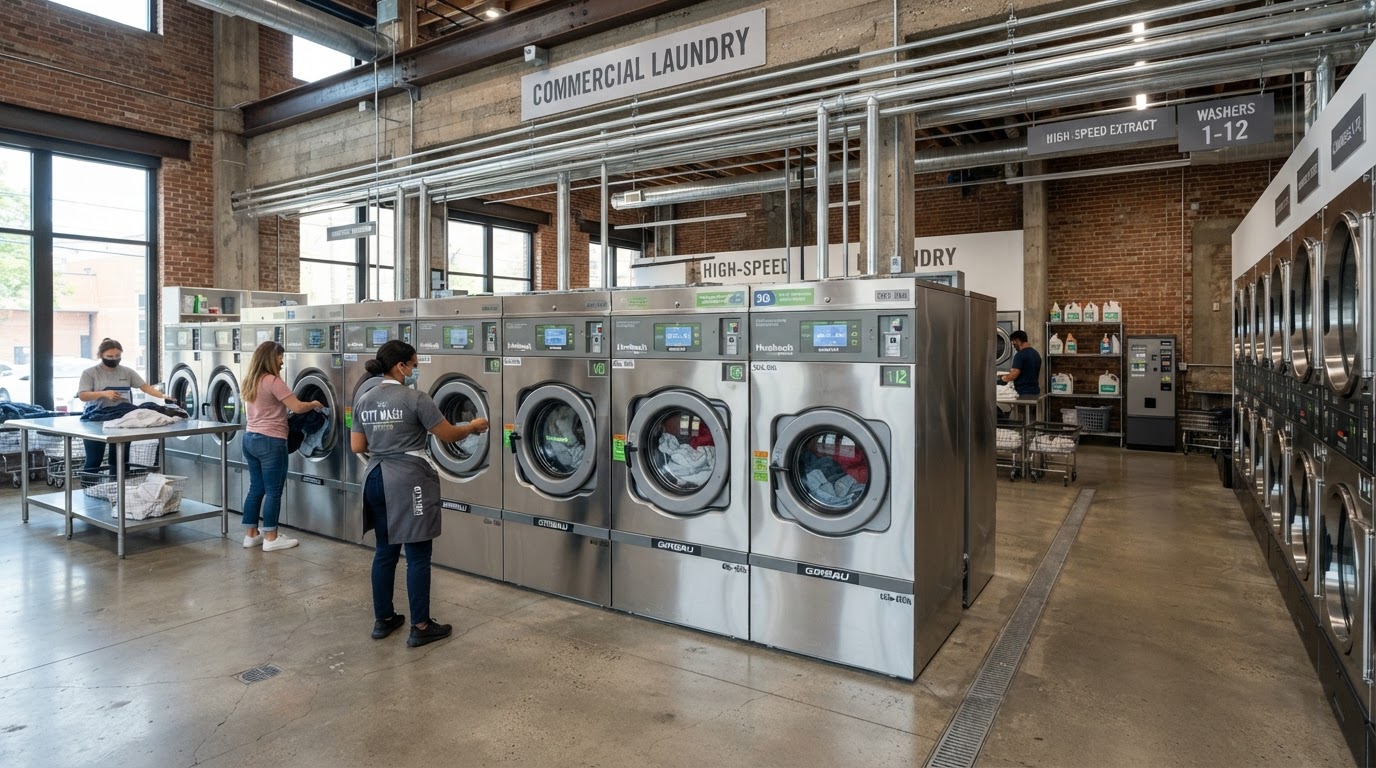
Every commercial laundry uses front-load extractors, and the reasons are the same as above: better cleaning, less wear, less water, higher extraction, and shorter dry times. For a household, the advantage is convenience and cost. For a commercial operation running thousands of pounds a week, the advantage is the difference between a profitable and an unprofitable operation. Our commercial machines run the front-load cycles and high-G extraction that residential machines cannot match.
The economics compound fast at commercial scale. A laundromat running fifty loads a day saves roughly a thousand gallons of water a day by using front-loaders instead of top-loaders — which is a real utility cost difference, on top of the faster turnaround (more loads per machine per day means more revenue per machine) and the longer garment life (which matters less to a laundromat but matters enormously to a commercial linen operator paying for the linens). The front-loader is the standard for commercial laundry because the math makes it the standard, not because of a preference.
The Trade-Offs
The front-loader is not without trade-offs, and the honest comparison includes them. Front-loaders cost more up front than top-load agitators. They have longer cycle times (the gentle tumble takes longer than the aggressive agitator action). The door seal requires periodic cleaning to avoid mold. And the bend-down to load is harder on the back than a top-load door. These are real considerations, but for most households the cleaning, water, energy, and fabric-wear advantages outweigh them over the life of the machine.
Frequently Asked Questions
Do front-load washers really clean better?
Yes. The lift-and-drop tumbling action drives water through the fabric more effectively than an agitator's dragging, which lifts soil more thoroughly while being gentler on the fibers.
Why do front-loaders use less water?
They do not fill the tub. The drum rotates through a shallow pool of water at the bottom, so only the minimum water needed for the load is used — roughly half of what a top-load agitator requires.
Are front-loaders better for delicates?
Yes. The gentle tumble is safe for wool, silk, and knitwear that an agitator would stretch and felt. Front-loaders also offer dedicated wool and hand-wash cycles.
Why does laundry dry faster after a front-load wash?
Front-loaders spin at higher G-force, extracting more water before the load enters the dryer. Less residual moisture means a shorter, cheaper, gentler dry cycle.
Should I switch from a top-load to a front-load washer?
For most households, the cleaning, water, energy, and fabric-wear advantages of a front-loader justify the switch. For the bulky loads a home machine struggles with, our commercial capacity handles them at a fraction of the time and cost.
Do front-loaders get moldy?
They can, if the door seal is not maintained. Wipe the rubber seal dry after loads and leave the door cracked between cycles to let it air out. A monthly hot wash with vinegar keeps the drum and seal clean.
The Front-Load Advantage
Front-load washers clean better, wear clothes less, use less water, and extract more for faster drying — four advantages from a single mechanical difference. Experience the difference at any Royal Clean location, where our front-load commercial machines run the cycles residential washers cannot.
Did you find this guide helpful?
Give it a heart to help other readers discover it.
Need Professional Drop-Off Wash & Fold in Winston-Salem?
Bring your delicates, bulky comforters, or commercial linens to 658 S Stratford Rd. Open daily from 5 AM to 11 PM.
Reader Discussion (2)
This guide completely saved my favorite cashmere sweater! I had no idea standard detergent was destroying the fibers.
We visit the Stratford Rd location every weekend for wash & fold. The staff is always so attentive!