
Why High G-Force Spin Extraction Reduces Drying Costs
G-force is the hidden cost driver in laundry. Higher spin extraction removes more water up front, slashing dryer time, energy bills, and the heat stress that ages your fabrics.

Marcus Vance
Master Cleaner
Why High G-Force Spin Extraction Reduces Drying Costs
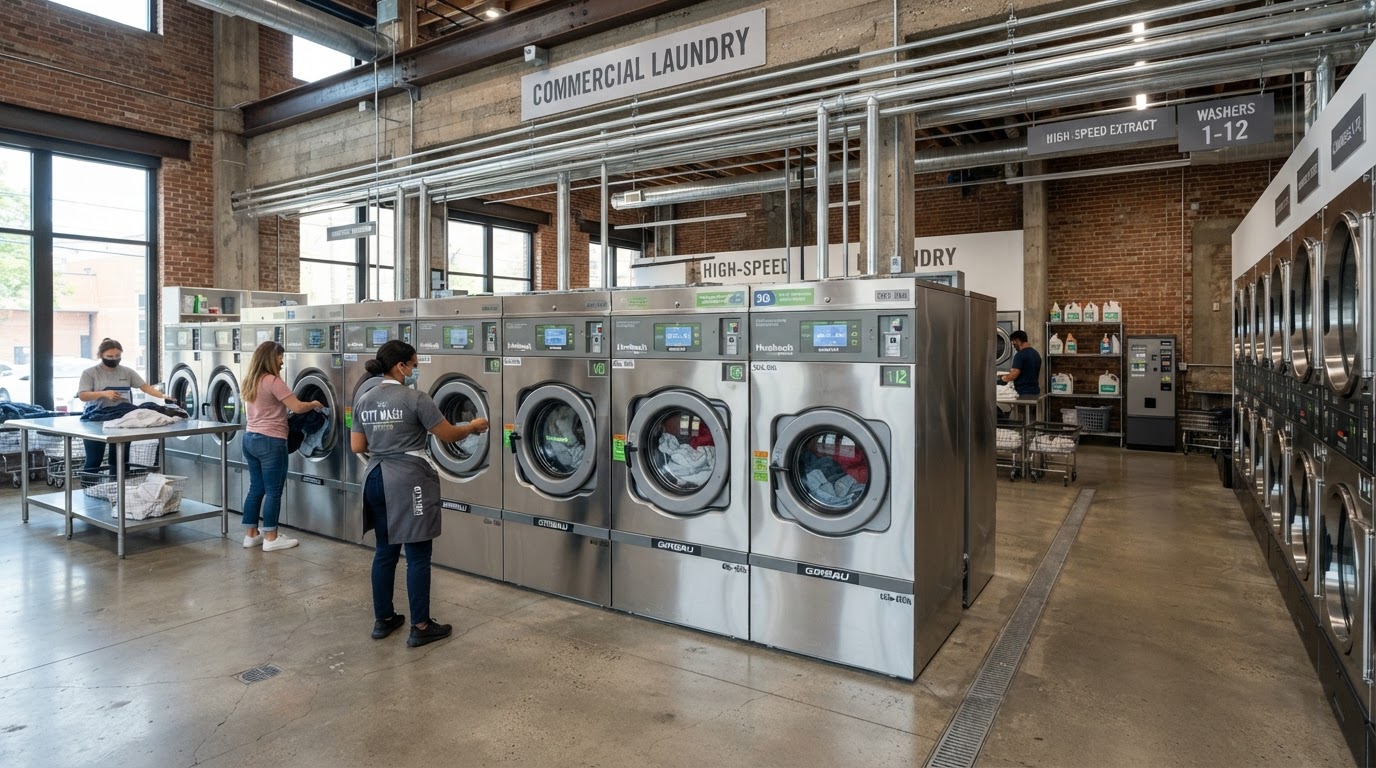
Drying is the expensive half of laundry. Heating a dryer drum uses vastly more energy than spinning a washer, and every minute saved in the dryer is money back in your pocket. The lever that controls that time is G-force — the centrifugal power of the washer's final spin. Higher G-force pulls more water out before the load ever reaches the dryer, which is why commercial laundromats outperform home machines on both time and cost. For anyone washing bulky loads — comforters, towels, blankets, workwear — G-force is the single most underrated variable in the cost of doing laundry, and it is the one almost nobody thinks about because it is invisible on the consumer machine's dial.
Experience 300+ G-force commercial extraction at our Winston-Salem Stratford Rd store or any Royal Clean Location across Greensboro, Winston-Salem, and Burlington.
What G-Force Actually Means
G-force measures how hard the spin cycle pushes water out of fabric. One G is normal gravity — the force that pulls water down through a hanging garment. A spin cycle at 100 G pushes water out a hundred times harder than gravity alone; at 300 G, three hundred times harder. The harder the spin, the more water leaves the fabric before the load ever enters the dryer. A residential top-load washer tops out near 100 to 200 G-force. Our commercial extractors hit 300 G-force or more. That extra centrifugal force can remove up to sixty percent of residual moisture from a heavy load, which is the difference between a comforter that dries in forty-five minutes and one that takes three hours in a home dryer.
To put that in perspective: the energy to spin a drum for ten minutes is a small fraction of the energy to heat a dryer drum for the additional two hours that a low-extraction load demands. G-force is the variable that decides whether your dryer runs for forty minutes or two hours, and that difference compounds across a year of laundry into real utility money. The math is the reason every commercial laundry uses high-G extractors, and it is the reason a laundromat can turn a comforter around in a single dry cycle while a home machine takes three.
The Cost Math
The economics of extraction are simple, and they favor high-G on every line:
A residential top-load washer leaving fifty percent residual moisture in a comforter means that comforter enters the dryer carrying a half-load of water that the dryer now has to evaporate at the highest energy cost in the laundry process. A commercial 300-G extractor pulling that same comforter down to twenty percent residual moisture hands the dryer a much lighter job — and the dryer runs for a fraction of the time, at a fraction of the cost, with a fraction of the heat stress on the fabric.
Why Commercial Laundromats Win on Cost
The compounding of these two facts — high-G extraction is cheap, dryer heat is expensive — is why a commercial laundromat can wash and dry a comforter for less than it costs to run the same load at home. The home machine's weak spin hands the home dryer a heavy, wet load that takes hours; the commercial extractor hands the commercial dryer a light, well-extracted load that takes minutes. The per-load utility cost is lower at the laundromat even before you account for the time saved, and the garment lasts longer because it spends less cumulative time in heat. For a household doing one or two bulky loads a week, the laundromat is cheaper on a fully-loaded basis than the home machine the bulky load is straining.
The Laundromat's Real Advantage
The reason a commercial laundromat can wash and dry a comforter for less than it costs to run the same load at home is the compounding of two facts: high-G extraction is cheap, and dryer heat is expensive. The home machine's weak spin hands the home dryer a heavy, wet load that takes hours of the most expensive energy in the laundry process to evaporate. The commercial extractor hands the commercial dryer a light, well-extracted load that takes minutes of the same energy. The per-load utility cost is lower at the laundromat even before you account for the time saved, the heat stress avoided, and the garment life extended — which is why the fully-loaded cost of a laundromat bulky load is lower than the fully-loaded cost of the same load at home.
For a Triad household doing one or two bulky loads a week — comforters, blankets, sleeping bags, the seasonal bedding rotation — the laundromat is cheaper on a fully-loaded basis than the home machine that the bulky load is straining. The home machine that handles everyday loads fine is the same machine that takes real wear from the bulky loads, and the wear shows up in bearing life and in the replacement comforters the home dryer's heat stress forces. The laundromat is the option that costs less in dollars, time, and garment life, and it is the option we point the bulky loads to at our stores across Greensboro, Winston-Salem, and Burlington.
The Cost-Per-Load Calculation
The cost-per-load calculation that makes the laundromat case for bulky loads is the one most households never run, and the numbers are worth laying out. A residential top-load washer on a bulky load runs a longer cycle and leaves fifty percent residual moisture, which hands the dryer a heavy load that takes two to three hours to dry. The dryer energy for that load is the largest single utility draw in the household for the day, and the heat stress on the comforter is the equivalent of three normal dry cycles' worth of aging. A commercial extractor on the same load runs a shorter wash cycle, leaves twenty percent residual moisture, and hands the commercial dryer a load that dries in forty-five minutes. The per-load utility cost is lower at the laundromat, the time cost is lower, and the garment-life cost is lower — three savings from a single choice of where to wash the bulky load.
The calculation also accounts for the wear on the residential machine, which is the cost most households never attribute to the bulky load. A residential washer's bearing is rated for a saturated load of maybe twenty to twenty-five pounds; a comforter's saturated weight can be forty or more, which is the load that ages the bearing prematurely and shortens the washer's life. The washer that would have lasted a decade fails in five years of regular bulky loads, and the replacement is the cost the household never connects to the comforters it ran through the home machine. The laundromat is the option that costs less in dollars, time, garment life, and machine life, and it is the option we point the bulky loads to across Greensboro, Winston-Salem, and Burlington.
Frequently Asked Questions
Does high spin damage clothes?
On sturdy fabrics, no. On delicates and wool, high spin can stretch and stress fibers, which is why we match spin speed to fabric type at our stores. A 300-G spin is appropriate for towels and bedding and not for a silk blouse.
Why do my towels take so long to dry?
Residential spin leaves more water in thick terry cloth. A commercial high-G spin removes far more moisture and shortens dryer time dramatically. Towels are the single load where G-force makes the most visible difference.
Can I get high-G extraction for bulky items?
Yes. Bring comforters and sleeping bags to Burlington S Church St for commercial extraction that cuts drying time in half. Our extractors are sized for the loads home machines struggle with.
What is residual moisture?
Residual moisture is the water left in fabric after the spin cycle. Higher G-force leaves less residual moisture, which means less work for the dryer and a faster, cheaper, gentler dry.
Does extraction save energy?
Yes — significantly. Removing water mechanically (spin) costs a fraction of the energy of removing it thermally (dryer heat). Every pound of water the spin pulls out is a pound the dryer does not have to evaporate at its highest cost.
Why is a laundromat cheaper than my home machine for big loads?
Higher G-force extraction removes more water cheaply, so the dryer runs for a fraction of the time. On bulky loads, the utility savings alone beat the home machine, before you count the time and the reduced heat wear on the fabric.
Spin Smarter, Dry Cheaper
G-force is the single biggest dryer-cost lever in laundry, and it is the one almost no one thinks about. Our commercial extractors remove more water up front so you spend less time and money drying every load — and your fabrics last longer because they spend less time in the heat. Try it at Winston-Salem Stratford Rd or any Royal Clean location across Greensboro, Winston-Salem, and Burlington.
Did you find this guide helpful?
Give it a heart to help other readers discover it.
Need Professional Drop-Off Wash & Fold in Winston-Salem?
Bring your delicates, bulky comforters, or commercial linens to 658 S Stratford Rd. Open daily from 5 AM to 11 PM.
Reader Discussion (2)
This guide completely saved my favorite cashmere sweater! I had no idea standard detergent was destroying the fibers.
We visit the Stratford Rd location every weekend for wash & fold. The staff is always so attentive!